Fire stop sealant
Sealant is the smallest part of fire stopping and the easiest to get wrong.
- Every seal labelled and photographed
- BM TRADA / FIRAS-certificated contractors
- Written price before any work
Fire stop sealant comes in a tube and goes on with a gun, which is why it gets used for everything. It is a good product for what it was tested for. Mostly that is joints between walls and floors, gaps round frames, and small gaps round cables or pipes inside a batt.
Intumescent or acrylic
Intumescent sealant swells when heated and fills the space left as things burn or melt. Fire-rated acrylic does not swell much, but it holds and seals well, and many linear joint systems use it. Some products are graphite-based, some ceramic. Which one is right comes from the data sheet for the job, not the colour of the tube.
Depth and backing
Most joint seals need a backing of mineral wool or a foam rod packed into the joint, with sealant on top to a set depth. The depth often matches the joint width for narrow joints and gets deeper for wider ones. Some joints need sealing from both faces of the wall, some from one. A bead smeared across the face of a gap, with nothing behind it, looks the same from a step back and does very little in a fire.
Where sealant is not enough
Round a 110mm plastic pipe. Across a hole bigger than a fist. Round a bundle of cables that has not been separated. Each of those needs a collar, a batt or a wrap, with sealant only as a finishing seal.
On the job
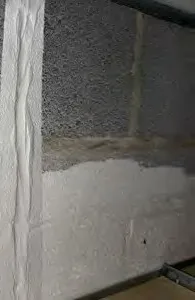
The photo on this page is a joint in blockwork after sealing, before the label went on. Our BM TRADA / FIRAS-certificated contractors record the product, the depth and the length for each joint they seal.
Send the postcode, the type of building and a photo or two. We will tell you whether it needs a survey first and what the sealing is likely to cost.