Cavity barriers and fire stopping in cavity walls
Fire does not need a hole you can see. A void inside a wall or above a ceiling will carry it just as well.
- Every seal labelled and photographed
- BM TRADA / FIRAS-certificated contractors
- Written price before any work
A cavity barrier is a seal inside a hidden space. A wall with a cavity, a floor void, the space above a suspended ceiling, the void behind cladding. Each of those can run from one compartment into another without anyone seeing it.
In a cavity wall
The two leaves of a cavity wall leave a gap between them. Where a fire wall or floor meets the outer wall, the cavity carries on past it. So the cavity needs closing at that line, usually with a sleeved mineral wool barrier pushed in from above or fitted during building. In an existing building this is hard to check without taking out a brick or a window, and we agree first where to look.
Above ceilings
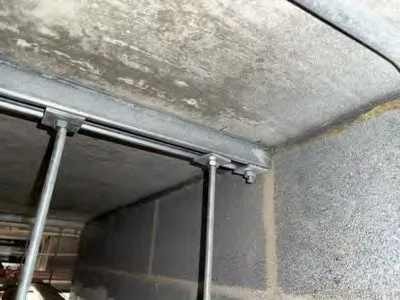
In offices and shops the wall often stops at the ceiling grid, and the void above runs right across. Sometimes the fire wall goes up to the slab, as it should, and the barrier is needed only where something crosses it. The photo here shows the top of a block wall with steel strut hangers and a tray at the slab, the sort of spot where a barrier or a seal is needed.
In roofs
Long roof voids over terraces and over flats are divided by cavity barriers, or by the party wall carried up to the roof. Victorian terraces in Camberwell or Nunhead often have neither in the loft.
Who checks
Barriers are often covered up once fitted. Photos before covering, and a mark on the plan, are how anyone knows later. Our BM TRADA / FIRAS-certificated contractors photograph each one before the board or ceiling goes back.
Send the postcode, the type of building and a photo or two. We will tell you whether it needs a survey first and what the sealing is likely to cost.